
Innovative Tire Sealants Win Respect From Tough Crowd
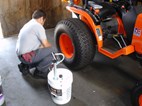
Reliability and big savings give peace-of-mind to truckers and transport firms
By Douglas Glenn Clark
The history of tire sealants reads like a tale of an unlucky man whose misdeeds don't keep him from trying to redeem himself.
An idea born 100 years ago, sealants have been accused of voiding product warrantees, interfering with tire retreads, corroding rims, causing wheel imbalances and, in general, shortening the life of the tire. These sealants are available in two types, the preventative sealant and the quick-fix remedy for a roadside flat.
 The aerosol sealants used after the fact to repair flats are usually flammable, can void tire warranties and frequently prevent permanent repairs. Tire shops dislike working on tires containing fix-a-flat type products often requiring the motorist to buy a new tire. They've been lauded (and lampooned) as a quick-fix remedy for a road-side flat. In other words, avoid them at all costs – unless, of course, you absolutely have no other choice.
Many of the preventative tire sealants deserve their dicey reputations too, as they can be reliably unreliable. Flammable and toxic, deemed an environmental hazard, some products even attack the tire, altering the composition of the rubber. They can also oxidize, resulting in rusted wheels and tire belts. And since these products often fall apart in the tire over time, they cause tire balance issues, and offer no permanent solution or peace of mind.
Fortunately, excellent tire sealants that improve road safety and help cut operational costs are available. A few industry leaders who never lost faith in the basic goal of the product group have developed products that meet today's exacting tire industry standards. These products use advanced corrosion inhibitors and state-of–the-art materials to seal punctures and prevent flat tires. Most tire sealants available today are suitable only for slow-moving, off-road and construction vehicles. Only a few of the leading products can be used in high-speed, over-the-road applications.
Tom Madson, manager of Parrish Tire in Winston-Salem, N.C., believes the tire sealant industry has the "fix-a-flat" variety of sealants to thank for its bad rap. "Don't ever put that stuff in your tire. If you do, you've created a monster," he said, referring to the inevitable damage caused by such products.
But even preventative products can wreak havoc. As these products break down, they can become acidic. An acidic environment will cause loss of air pressure, not necessarily because the rubber has eroded, but because the wheel has been compromised. "I've seen some products eat steel wheels or pit aluminum rims in as little as six months," he said.
And then there are those products that claim they can fix a one-inch hole in the tire. But large objects can cause severe belt and structural damage to a tire, making it unsafe to keep in service. Madson is suspicious of sealants that guarantee repair of holes bigger than ¼ inch. "You don't want to use any tire sealant that will seal injuries greater than ¼" in diameter in over-the-road, high-speed applications," noted Madson.
That doesn't mean Madson isn't a believer in premium preventative products that keep the wheels rolling on the commercial truck fleets he services. A quality sealant can save trucking firms enormous sums of money simply by reducing the times a truck is stopped by the side of the road to repair a flat, or by preventing a blowout caused by an under- inflated tire.
"I had one fleet manager call me thirty days after I'd serviced his trucks with my sealant of choice, Ride-On. His after-hours road calls for service went down and he saved a lot of money. Now not a tire in the fleet is without the sealant. They can't afford to be on the side of the road with a flat. Those trucks have to run twenty-four hours a day," he said.
This sealant also helps the fleet maintain their optimum tire pressure, resulting in improved fuel efficiency and increased tire life. "The biggest enemy of a tire is under inflation which results in heat," Madson said.
Randy Schimchak agrees. Schimchak is tire shop foreman for New Century Transport in New Jersey. His job is to service the tires that are needed to keep 1,000 tractors and 2,000 trailers rolling down the highway. "When tires start losing air pressure, they heat up real fast and that's what causes road failure, even a blowout. We find it necessary to have a tire sealant we can rely on," he said, adding, the cost of replacing the wide-base, super-single tires they use on their tractors and trailers is more than $700.
 After years of trial and error, Madson and Schimchak both opted to use the Ride-On Tire Protection System (Ride-On TPS) tire sealants. This revolutionary line of tire sealants was developed by Inovex Industries, Inc., based in Sterling, Va. Inovex President Mark Farkhan adds, "Our sealants are used in over 250,000 vehicles including more than 40,000 of the wide-base tires" (often referred to as super-singles).
Schimchak said it was initially difficult to sell his boss on the idea of using a tire sealant. A lot of sealants that claim to be "the best on the market" rapidly fail to impress. But an Inovex representative offered a challenge. He asked Schimchak to mount brand-new tires on a New Century tractor and drive it over a 2 x 4 board that had eight sharp nails sticking out of it. The nails punctured the tires, but there was no loss of air pressure. Those tires remained in service until their treads were worn to the legal limit. That sealed the deal.
"My boss said it was the first time in twenty years he found something that really worked. And it's not a temporary seal. It seals the hole for the life of the tire. It saves us a ton of money," said Schimchak. In four years of using the sealant, the company has not had a single issue with retreading or corrosion and has also observed firsthand another important attribute of Ride-On, that of dynamic balancing and the more even tire wear - especially on our wide-base, super single tires – that results from having a balanced wheel assembly.
Madson is familiar with the nail demo, too. In fact, he uses his own truck to prove the effectiveness of the sealant. "I've punctured a sixteen-inch tire on my truck ninety-nine times and never had a flat. It took me over a year to do it, because I don't just do it for the heck of it."
Madson also recommends Ride-On TPS to operators of slow-moving off-road equipment, such as in bobcats, backhoes and loaders. One landscaper who once complained that the tires on his zero-turn lawn mowers were in constant need of repair decided to try the sealant. Since then, "…he's the happiest guy out there. He's still running stuff we put in there seven years ago." Madson adds there is one common reason truckers, motorists and even motorcycle enthusiasts use the sealant: "Peace of mind."
Fortunately, through the years, the saga of a formerly distrusted yet much-needed product has been transformed into a tale of goodwill and contentment. Today, no one has to settle for an inferior product. With a little homework, you can find a tire sealant that delivers on what it promises.
For more information, contact Inovex Industries, Inc., 45681 Oakbrook Court, Unit 102, Sterling,Va., 20166. Phone 1-888-374-3366 (1-888-3-RIDE-ON) (Fax 703-421-1967; or visit the web site: www.ride-on.com
SOURCE: Inovex Industries, Inc.